

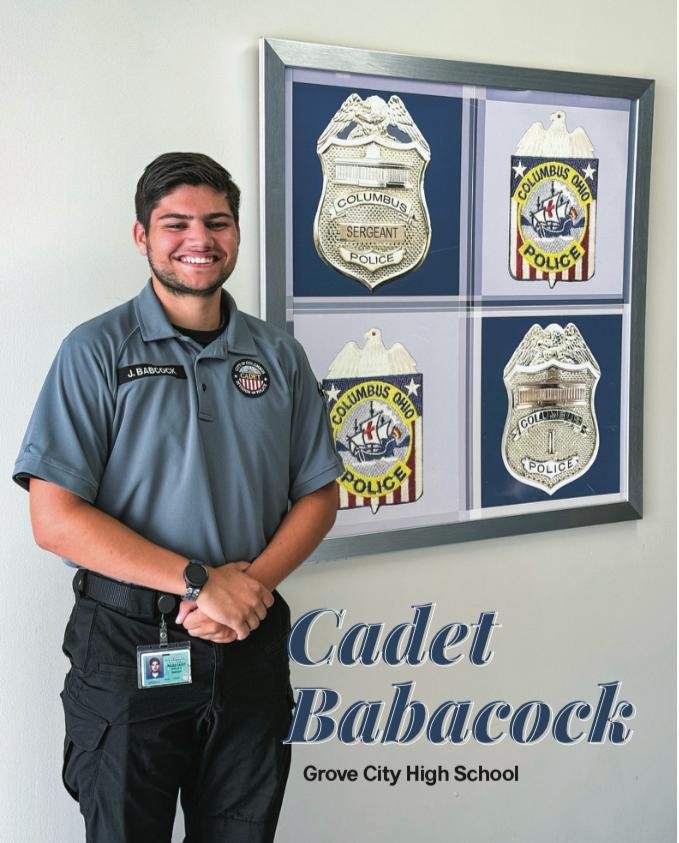
For many children, wanting to wear the badge is a passing phase alongside dreams of becoming an astronaut or a doctor. For Cadet Babcock, it was the start of a lifelong path. Raised in a household grounded in public service with a father already serving on the force at CPD, wearing the uniform wasn’t just a hypothetical future; it was a daily inspiration. Today, Cadet Babcock is turning that childhood ambition into action, driven by a deep commitment to protect, serve, and give back to the local community.
What sparked your interest in joining the Columbus Police Cadet Program?
I’ve always wanted to be a police officer since I was a child. Everyone always says they
want to be a police officer, astronaut, doctor kind of thing, and I wanted to pursue law
enforcement.
My dad’s a police officer with CPD, so it’s always kind of been a dream. I want to have
an impact on my community, and I just want to be able to help people and protect
people.
Were there any specific moments or people in your neighborhood who inspired
you to persuade law enforcement? Well, you just said your dad.
My dad. He’s been on for 30 years, so he’s had a huge impact. Seeing him coming
home and leaving every day, having that relentless perseverance to aid the community,
even when he had a long day or even with us four children running around.
He always got up and went out and served the community to the best of his ability and
then came home and would be a dad. And he never failed to come to a game, never
failed to show up for me and for the community. He is just a very strong leader and just
exactly what I want to be.
And another person, because I was in the PSC program, which is kind of our youth
program here, and so I have a few mentors here, Officer Johnson and Drake. They
really brought me into this. Really showed me what it’s like to be a police officer, but not
just kind of putting bad guys away police officer, but really protecting and serving the
community and engaging, going to those events and talking with people and just really
getting your name out there and just saying, “Hey, how’s it going? How are you doing?”
Great. What is the biggest misconception that teenagers have about police
officers, and how do you hope to change that?
I think a lot of people think that police officers are just out there to get you. At the end, to
catch you slipping and to catch you when you make a mistake. And I’ve heard a lot from
people who really were doubting me or telling me I shouldn’t pursue this career because
of that. People are like, “Oh, they’re just out to get you, just out to put you away.” And I
was shown the other side, and I want to show people the other side of police officers,
which is at the core, they’re all human too, and all they really want to do is interact with
the community as well. There’s a part of the job, which is protecting and serving, but it’s
also that serving piece, which is going to all those events, talking to people, showing
people that.
Get to know them.
Yeah. Get to know us, talk to us, hang out with us. We want to share funny moments
and happy moments and just get to know people. I was shown that and I want to show
other people that.
What is the most challenging physical or mental hurdle you had to overcome?
That’s a good one. I’d say probably the fact that knowing I’m going into a career where I
can make such a big impact on someone and kind of a rough time that they’re going
through.
As a police officer, you see people at their lowest moments, and the decisions that you
make will influence their life and influence their decision-making and influence
everything thereafter about their opinion with whether that’s cops or just kind of how
they go about their day. I want to make sure that I’m making every right decision, I’m
treating every single person correctly, and making sure that I’m following that golden
rule, and just making sure that I leave people with always a more positive impact and
leaving them better than when I found them. So, I guess that kind of impact that I’m
going to have on people’s lives worries me a little bit, that I want to make sure that I’m
doing everyone right.
As a candidate, you’re a part-time employee. How do you balance this demanding
program with your personal life and other teens’ interests?
Well, I think that in this program, it’s a higher responsibility because we’re here at the
academy, because we represent the Columbus Division Police. So there definitely is a
responsibility there to make sure that I’m watching what I’m doing and making sure that
I’m serving my community and really putting myself out there and starting that early
because I’m not a police officer yet, but that doesn’t mean I still can’t start serving my
community now. So, I’m involved in the PSC program.
I’m just trying to get another job at Nationwide to do some security there. I still hang out
with my friends. I still do pickleball and all that stuff with them. I still catch up with some
of my buddies that play football, go hiking, do all that stuff.
Sometimes, it can be a task balancing both, but I think that the program has made it
very easy, and it’s been very fun to just come here and train. And I look at it in a very
positive light. I’m getting paid to come here and learn what I want to do for the rest of my
life, and then I get to leave here and go do whatever because I’m still a teenager.
The Columbus Division of Police focuses heavily on building trust. How do you
plan to use your youth and perspective to connect with Columbus youth?
I kind of want to reach people where they are and relate. I think that’s the biggest thing
about how you can really get a point across or bond with someone is like, “Hey, I’ve
been there. I really want to help you get their point of view.”
Get people’s point of view.
Exactly. Get their point of view, step into their shoes. Even if I’ve never been there
before, even if I don’t know what that feels like, I still want to do my best to understand
the position that they’re in and understand what they’re going through so that I can kind
of relate to them best.
I think with my age and being young, I can go up to another 19-year-old and be like,
“Hey, man, I’ve been there before,” or, “I haven’t been there before, but I want to help
you best. I want to show you what I’m doing,” and show them that at this age, we can do
so many things like law enforcement, this early.
Looking ahead to when you turn 21 and can take the civil service exam to become
a sworn officer, what kind of impact do you want to make on the city?
I suppose the biggest one is changing the relation between citizens and cops. I think it’s
kind of separated right now. And I think that the biggest impact I want to do going into
taking that civil service and getting on the job is I want to start really building
relationships as police officer that to the point whenever I go out on patrol, I know
people by name, and they know me by name. Like, “Hey, how’s it going, Officer
Babcock?” Or I’ll know people on the street, wave, say hi, check in on people. That’s
really what I want to do. I want to build a bond with the people that I’m serving.
What advice would you give to other teenagers who are interested in law
enforcement, but aren’t you sure where to start?
I would say get into the youth programs. If you’re below 20, I know Columbus, like I
mentioned, we have our Public Safety Corps program. We have our cadet program.
Reach out. You can go on ride-along as well. When you turn 18, you can go on two
rides a year. Reach out to your local police department and dip your toes in the water.
See if that’s how you like it. You can just go and just live the day of the life of an average
police officer, meet police officers, and stuff like that. You’ll only know if it’s what you
want to do when you start taking the steps to do it. When you start to experience it for
yourself, that’s when you’ll know what to do. And if you’re thinking about it, I absolutely
encourage people to do it. It’s a great career. You get to influence and help a lot of
people, and overall, it’s a great pathway.
Did you do that, or did you just have your dad just kind of push you?
I mean, my dad was an influence, but this was pretty much all me.
Why did you choose to join the force?
I think it was a calling. To be honest, I think it was a calling from the Lord that He just
really set out for me to that I just really want to help people. I’ve always had a service
heart. I’ve always just wanted to leave everyone else with a positive impact and just that
I can say, walking away confidently from every situation I’ve been in, that I helped that
person in some way, shape, or form.
If you didn’t pick this career, what else would you do? Would it still be helping
people or totally different?
It’s kind of funny. It’s totally different. I would do meteorology. I love weather, tornadoes,
all that. So, if it wasn’t this, I’d be a storm chaser and a weatherman.
Interview by: Jaila Mccarey

Leave a Reply